
A note from the archive: The historical events linked below are real. Their connection to the Elsewhere and the Assemblies is fictional. The Assemblies are best understood as responses rather than causes: communities face crisis, develop ways of enduring it, repeat what works, and eventually give those practices names.
The Assemblies were never four.
There have been periods when none were recognized, periods when two or three traditions carried most of the work, and periods when older distinctions became less useful and new ones emerged. The four names familiar to visitors of the Curious Cauldron today—Moonmere, Emberwing, Thornvale, and Starforge—are current conveniences, not permanent laws of magic.
Later historians, particularly Benjamen M. Lucerne, preferred cleaner diagrams. History has consistently declined to cooperate.
Before the names
The oldest records do not describe Assemblies at all. They describe communities trying to remain useful under pressure.
Some traditions concentrated on distinguishing what was known from what was feared. Others built systems for moving food, medicine, messages, and people quickly. Some widened the meaning of kinship when families and neighborhoods had been violently disrupted. Still others gathered methods from several traditions and built tools that none of them had possessed before.
The names came later.
The crises came first.
Moonmere: preparation before certainty
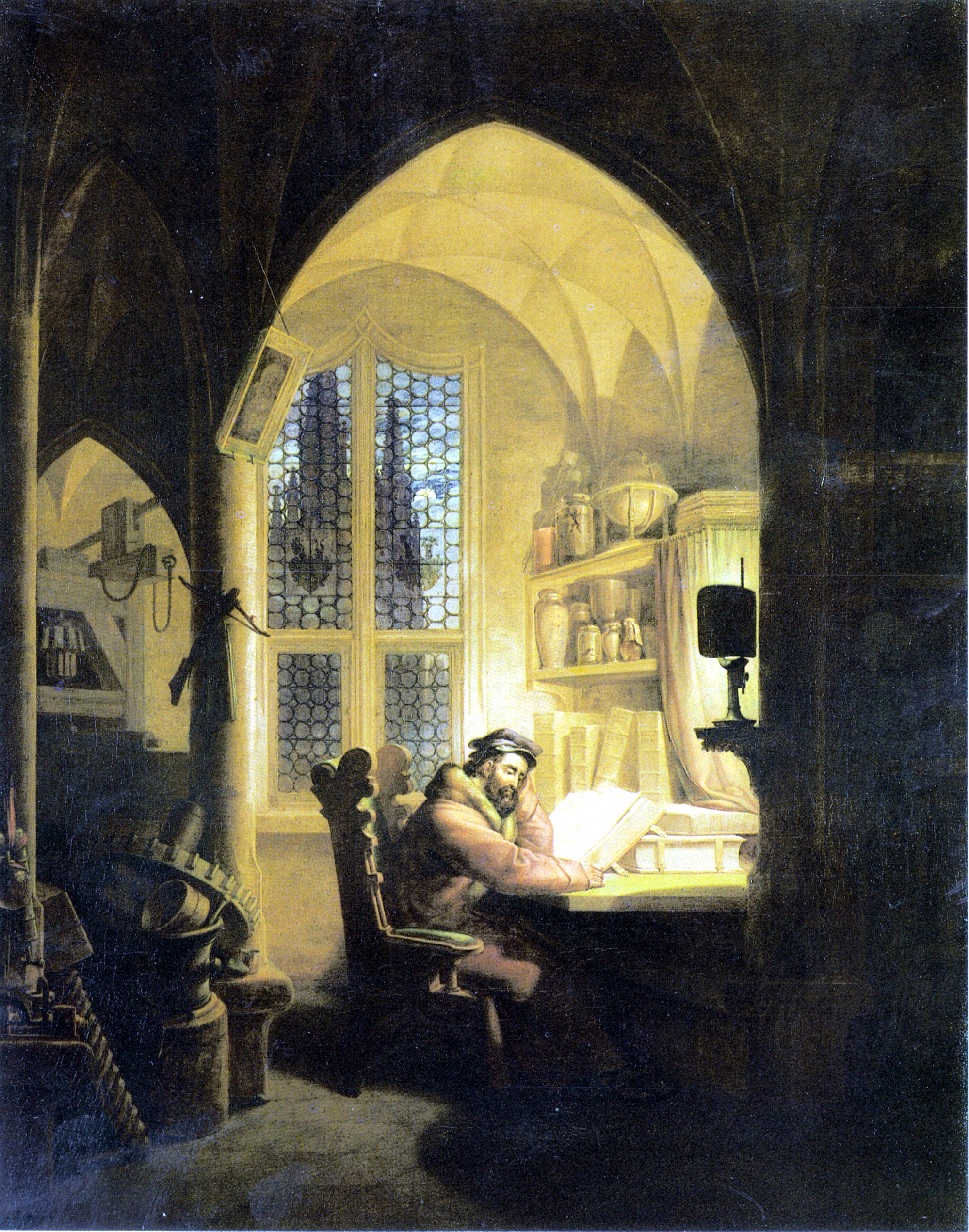
Among the oldest identifiable traditions are communities later associated with Moonmere: record keepers, observers, translators, physicians, astronomers, mapmakers, and scholars who treated uncertainty as a reason to investigate rather than panic.
Chinese evidential scholarship offers one useful historical parallel. During the Qing dynasty, kaozheng—evidential research—placed unusual weight on close examination of texts, language, evidence, and historical context. What began partly as an effort to recover reliable knowledge also encouraged scholars to question whether inherited claims were as certain as they appeared.
Historical source: Stanford Encyclopedia of Philosophy: Qing Philosophy
The maxim most often associated with the early Moonmere tradition is less elegant than its scholars would prefer:
A prepared mind gives chance something to work with.
Moonmere scholars consider this an unacceptable simplification, which is one reason everyone else continues to use it.1
The tradition changed as the scale of catastrophe changed. The Taiping Rebellion of 1850–1864 devastated large portions of China and became one of the deadliest conflicts in history. In later Moonmere writing, preparation gradually expands into preservation: not merely knowing what is true, but asking what knowledge survives, whose records are protected, and whose disappear.
Historical source: Smithsonian National Museum of Asian Art: Timeline of Chinese History, Art, and Culture
Emberwing: responsibility under uncertainty
Other communities reached a different conclusion: sometimes the need is already clear even when the larger situation is not.
In Ottoman cities, charitable endowments known as vakıf supported food, education, housing, medical care, livelihoods, and relief in times of disaster. These systems were religious, civic, economic, and practical at once. They made care part of the infrastructure of everyday life.
Historical source: Cambridge University Press: Welfare in Ottoman Istanbul
Later Emberwing chroniclers saw kinship with traditions built around hospitality, transport, neighborhood responsibility, caravan routes, emergency relief, and public protection. Their question was not simply, What do we know? It was:
If the need is known, uncertainty about everything else does not excuse abandoning it.
Moonmere and Emberwing have argued about the distance between those two sentences ever since.
Thornvale: community after forced absence
Thornvale’s deepest history is not a story about suffering making people kinder. It is a story about communities deliberately rebuilding connection after people have been taken away.
The transatlantic slave trade and the warfare, raiding, forced migration, and demographic disruption surrounding it altered communities across West and Central Africa for centuries. In some places, population loss—particularly the removal of men—changed household structures and forced communities to reorganize responsibilities that had once been carried by people who were no longer there.
Historical source: The Metropolitan Museum of Art: The Transatlantic Slave Trade
Later Thornvale scholars, including several working in Yoruba and neighboring West African traditions, described the central question this way:
How does a community remain a community when the people expected to hold it together are missing?
The answers varied widely: broadened kinship, shared responsibility for children and elders, protected food systems, collective memory, mutual defense, healing, and the deliberate creation of belonging beyond the immediate household.
Thornvale did not invent these practices. The Assembly name came much later. It became a way of recognizing a recurring principle: community can be rebuilt on purpose.
1815: the crisis that would not stay put
In April 1815, Mount Tambora on Sumbawa Island in present-day Indonesia produced one of the largest explosive eruptions in recorded history. The local destruction was catastrophic. The eruption also sent enough material into the atmosphere to alter weather patterns far beyond Southeast Asia, contributing to global cooling and widespread crop failures.
Historical source: Smithsonian Global Volcanism Program: Tambora
Assembly historians later treated Tambora as an important corrective. A crisis could begin in one community and become the concern of people thousands of miles away. Records alone were not enough. Rapid response alone was not enough. Local care alone was not enough.
People needed ways to exchange knowledge, adapt tools, move resources, and borrow methods from neighbors.
This is one of the periods in which the traditions later called Moonmere, Emberwing, and Thornvale begin to overlap so thoroughly that historians become unusually argumentative about labels.
Starforge: when the answer has to be made
Starforge appears later than the other current Assemblies, and this is important.
It did not begin as a fourth answer waiting neatly beside three others. It emerged from crossings: observers working beside responders, craftspeople beside healers, mathematicians beside farmers, engineers beside navigators, and communities discovering that identifying a problem did not automatically produce the tool required to solve it.
If the answer does not yet exist, making it is also an answer.
Starforge was mixed from the beginning. Attempts to assign it to one culture, nation, or people have generally revealed more about the historian than the Assembly.2
1838–1839: the limits of the four
The forced removal of the Cherokee from their homelands in the southeastern United States became another turning point in later Assembly scholarship. More than 16,000 Cherokee were forced from their homes beginning in 1838; many died during confinement, removal, and its aftermath.
Historical source: National Park Service: Trail of Tears National Historic Trail
Older Assembly histories sometimes tried to interpret every community response through one of their existing categories. Later scholars increasingly rejected that habit.
Cherokee history did not need to be translated into Moonmere, Emberwing, Thornvale, or Starforge in order to be understood as meaningful, sophisticated, resilient, or instructive.
The Four were never the only voices.
This principle remains one of the most important restraints on Assembly scholarship. A useful category can become a poor lens when it insists on describing everything.
1845–1852: what does neighbor mean?
The Great Hunger in Ireland sharpened another question. Potato blight devastated a population already living under severe economic and political pressures. Starvation, death, and mass migration followed; within five years roughly a million people had died and hundreds of thousands had emigrated to the United States alone.
Historical source: Library of Congress: Irish-Catholic Immigration to America
Assembly records from later generations return to an uncomfortable question:
What if your neighbor’s weakness benefits someone else?
Moonmere could identify systems. Emberwing could respond to immediate need. Thornvale could rebuild networks of care. Starforge could design alternatives. None of those answers, by itself, resolved the structures producing the crisis.
Four answers emerged from recurring fear and failure. None proved sufficient alone.
The Great Exchange
By the later nineteenth century, migration, ports, trade, scholarship, diaspora, conflict, and ordinary human curiosity had made the traditions increasingly difficult to separate.
People borrowed methods. They married across traditions. They changed their minds. They learned techniques from communities that recognized no Assembly at all. Some left one Assembly and were later recognized by another. Some never sought recognition.
The Assemblies slowly became less like answers and more like communities gathered around recurring ways of serving.
Within each answer lived thousands more.
Work without the name
Most people who live according to an Assembly’s values have never heard its name.
This has generally been considered a feature rather than a problem.
Charles Monroe Sheldon, pastor of Central Congregational Church in Topeka, offers a useful local example. Sheldon was associated with the Social Gospel movement, wrote In His Steps, and became known for the question, “What would Jesus do?” He and his congregation also supported practical efforts addressing social problems in Topeka.
Historical source: Kansas Historical Society: Charles Monroe Sheldon
Later Thornvale chroniclers have occasionally described Sheldon’s work as parallel practice: a person living principles recognizable to an Assembly without being a member of it, knowing its name, or possessing magic.
Lucerne called Sheldon “Thornvale-adjacent,” a term no one else appears to have liked.3
The distinction matters.
The Assembly names describe a way of serving. They are not claims upon the person who serves.
Why the Curious Cauldron matters
The Curious Cauldron became important not because it belongs to one Assembly, but because it does not.
It offers privacy, security, and neutral ground: a place where people may speak openly about work that is usually done quietly in the ordinary world. Traditions can compare methods without turning difference into division. Rivalries can be tested without becoming wars. Resources can move. Disputes can cool. New ideas can be tried among people who understand the stakes.
Once each year, those traditions gather around the HearthWarming and collect Sparks through service, curiosity, courage, invention, care, and shared effort.
The competition is real.
So is the purpose behind it.
Magic that proves the steward powerful has accomplished little.
Magic that leaves the neighbor secure has fulfilled its service.
The number and names of the Assemblies may change again. If communities need a new distinction, one may emerge. If an old distinction stops being useful, it may disappear.
An Assembly may give a person a place to stand. It should never tell them where they are allowed to look.
But the Hearth is stronger because all are invited.
Notes from the archive
1 Louis Pasteur later expressed a similar idea in the line commonly rendered as “chance favors the prepared mind.” Lucerne devoted an unnecessary amount of ink to establishing that Moonmere had said it first. Moonmere scholars considered this unnecessary because they already knew.
2 Lucerne attempted this twice. The second edition quietly removed a chart from the first. No surviving correspondence explains the decision, which has not stopped scholars from explaining it at length.
3 Lucerne himself appears to have agreed with the principle that a source should not be trusted merely because it is cited, at least when discussing everyone except Lucerne.
Archive maxim: Lucerne may be cited. Lucerne may not be trusted merely because Lucerne is cited.

Leave a Reply