
Recorded by Parker Tender
Warden of the Embers · First Celebrated “something” of the Bardic College · 1919–1926
A Most Improper Treatise Upon Carnival, Crowns, and the Cultivation of Magnificent Whiskers
Come fiddlers! Come fools in impossible hats!
Come scholars with spectacles! Come ladies with cats!
Come tinkers and tailors and makers of cheese!
Come people with whiskers that sway in the breeze!
Ahem.
I trust that has adequately established the scholarly nature of these proceedings.
There exists, among the most tiresomely respectable members of society, a belief that civilization depends upon obedience, punctuality, sobriety, and the wearing of appropriate trousers.
Such people have clearly never attended Carnival.
For centuries, communities across Europe have embraced the marvelous notion that the proper order of things must occasionally be turned upon its head.
Before the solemn obligations of Lent came the feasting of Carnival. Masks appeared, music erupted, processions filled the streets, and ordinary folk discovered the exquisite pleasure of behaving in ways that would ordinarily distress the local magistrate.
Elsewhere, the Lord of Misrule and the Feast of Fools celebrated their own varieties of festive reversal. Though these customs had different histories, they shared an excellent possibility:
What if, just for one night, the people who make the rules were made to look ridiculous?
The baker might become a baron. The washerwoman might become a queen. A chimney sweep might command the mayor to dance a jig while balancing a turnip upon his head.
And the mayor, if possessed of sufficient wisdom, would dance.
If possessed of insufficient wisdom, he would dance badly.
Either outcome would benefit the community enormously.
Concerning the Ancient Wisdom of Being Utterly Ridiculous
A crown for the cobbler! A broom for the king!
A dance for the duchess! Let everyone sing!
The rich and the ragged, the clever, the daft,
May find themselves equal when everyone laughs!
Carnival did not abolish poverty, injustice, or the ordinary difficulties of existence. It did not. But it offered something exceedingly valuable: for one evening, people might glimpse a world in which rank mattered less than imagination and nobody possessed a monopoly upon joy.
Which brings us, naturally, to Thomas Vale.
Thomas Vale and the Fourth Keeping
The archives tell us that during the winter of 1894, young Thomas Vale discovered an unusual affinity for fire.
A little flame might lean toward him. A dying ember might brighten beneath his attention. The boy could coax a spark to endure.
Most extraordinary. Most mysterious. Most inconveniently insufficient for heating an entire house.
Fortunately, Thomas possessed another talent: he could make people laugh.
When the Vale family faced the prospect of losing their fire, Thomas offered his younger sister a piece of advice involving tears, water, and the unnecessary waste of both.
She responded by throwing a cushion at him.
Thus began, according to certain authorities, the first documented magical combustion of laughter.
I am aware that other scholars dispute this interpretation. Other scholars may acquire their own quills.
As the neighbors gathered around the Vale hearth, something extraordinary occurred. The baker sat beside the railway porter. The widow corrected the gentleman. Children interrupted adults. Occasionally, somebody sang.
Thomas recognized something familiar from his reading: the fool-kings, masked processions, and revels in which an ordinary village might become, briefly, a most extraordinary place.
Thus, of the Seven Keepings of the Hearth, the Fourth—Merriment—became the most gloriously unpredictable.
The first three had concerned themselves with sensible matters: shelter, sustenance, and fellowship. But the Fourth demanded something far more dangerous.
That people should enjoy themselves.
Preferably in public.
And, whenever possible, at the expense of their own dignity.
Thus were born the Rituals of Misrule.
A fire warms those who gather. Merriment gives them a reason to gather in the first place.
The Four Great Laws of Misrule
I have collected these laws from various records, tavern walls, and one exceptionally argumentative grandmother.
The First Law: Every person may participate, whether titled, untitled, wealthy, penniless, young, old, seated, standing, or possessing a beard of questionable authenticity.
The Second Law: Authority shall be borrowed, inverted, mocked, and returned in approximately the condition in which it was found.
The Third Law: No individual shall be considered too grand, too important, or too dignified to become the subject of affectionate nonsense.
The Fourth Law: No individual shall be compelled to perform, endure humiliation, or surrender their dignity against their wishes. A willing fool is a treasure. An unwilling one is a grievance.
The quietest person can contribute a spark. Occasionally the quietest person possesses the most dangerous sense of humor. I speak from experience.
The Crowning of the Sovereign of Misrule
Every respectable celebration requires an authority figure.
Every truly splendid celebration requires an authority figure whose authority is entirely imaginary.
Thus we appoint a Sovereign of Misrule.
The Sovereign may proclaim ridiculous laws, settle imaginary disputes, command performances, and adjudicate contests of no conceivable importance. Their decrees possess no legal standing whatsoever.
This has never prevented certain Sovereigns from behaving as though they govern half the Empire.
The crown may be made of brass, paper, ribbons, or whatever survives the previous evening’s festivities.
A particularly unfortunate Sovereign once wore a chamber pot.
The archives decline to elaborate.
The Five Trials of Facial Topiary
And now, dear reader, we approach the most important ceremony in the entire history of human civilization.
I refer, naturally, to the Beard Contest.
I recognize that certain scholars will object. They may write their objections upon parchment, roll the parchment tightly, and employ it in whatever manner seems most educational.
For the Beard Contest is no ordinary competition.
A person enters as an ordinary citizen. They emerge as a wizard of whiskers, a sovereign of stubble, a monarch of magnificent facial foliage.
Five trials determine their fate.
Trial the First: Contestant & Beard Name
No beard may enter the sacred proceedings without a proper introduction. A contestant must declare both their own name and the name of their beard.
Consider Professor Pendleton’s Perilous Pompadour, The Grand and Glorious Bramble of Blackthorn, Her Imperial Whiskerness, Duchess of Disarray or, should imagination fail completely, Gerald.
Name it! Claim it! Let everyone hear!
Give glory and grandeur to every last hair!
For a beard without title, however well grown,
Is merely a forest without any throne!
Trial the Second: The Tragic Backstory
Every truly magnificent beard requires a tale of suffering.
Perhaps the whiskers grew during seven years of exile. Perhaps they were cursed by a jealous enchantress. Perhaps the contestant awoke one morning to discover that their moustache had developed ambitions of its own.
Accuracy is not the primary purpose of this trial.
That would be scholarship.
This is Misrule.
Trial the Third: Evil Laugh & Beard Manipulation
A wizard without an evil laugh is like a kettle without a spout.
Contestants must demonstrate their most villainous laughter while stroking, twisting, flourishing, or otherwise manipulating their facial magnificence.
The laugh may rumble like thunder, squeak like a distressed mouse, or resemble a goose trapped inside a trombone.
The audience must believe, if only for an instant, that this contestant intends to conquer the world.
Preferably before supper.
Trial the Fourth: Facial Topiary
Here the beard becomes art.
Wax may be applied. Braids may be constructed. Ribbons may flutter. Small ornaments may appear among the whiskers.
A beard shaped like a sailing ship? Splendid!
A moustache resembling the antlers of a particularly astonished stag? Marvelous!
A miniature garden complete with decorative fencing? Perhaps excessive.
Comb it! Curl it! Construct it with care!
Build towers and turrets of troublesome hair!
Let whiskers grow westward and moustaches grow east,
Till the chin of a mortal resembles a beast!
Trial the Fifth: Best Beard
At last, all nonsense falls silent.
Briefly.
The contestants assemble before the gathered Assemblies. Each presents their beard in its final glory. No tragic tale need be repeated. No villainous laughter is required.
The beard must stand upon its own merits.
Or hang from them. Or curl around them.
The company votes. Friendships tremble. Alliances collapse. People who have never expressed an opinion about facial hair suddenly develop passionate convictions concerning symmetry, volume, and the ethical responsibilities of moustache wax.
The Wardens record the results with solemn ceremony.
The losers are encouraged to behave graciously.
This instruction is seldom obeyed.
The Reckoning of Sparks
Every contestant remains eligible through all five trials. Each guest may cast one vote during each round.
Every contestant who enters contributes twenty-five Sparks to their Assembly.
The first-place contestant earns an additional two hundred Sparks; second place, one hundred; third place, fifty.
The Sparks join the Gathering and strengthen the communal Hearth.
The Assemblies compete. The contestants boast. The judges deliberate. The audience argues.
Yet every act of participation makes the common flame brighter.
Thus the Wardens have accomplished something that generations of monarchs and philosophers failed to achieve: people may quarrel enthusiastically while working toward precisely the same purpose.
Naturally, the discovery involved beards.
In Defense of the Gloriously Absurd
Let the historians have their solemn processions. Let the magistrates preserve their regulations. Let the philosophers debate whether laughter possesses any genuine power.
We Wardens have watched strangers become neighbors and neighbors become families. We have seen people who believed themselves invisible stand before a room and receive a roar of applause.
Magic does not always announce itself with thunder.
Sometimes it arrives wearing a ridiculous hat. Sometimes it carries a fiddle. Sometimes it sings seventeen verses of a song that ought never to have possessed more than three.
And sometimes it takes the form of an elaborate beard being judged by people who have absolutely no qualifications to judge it.
So let the foolish be festive! Let the pompous be kind!
Let the last of our worries be left far behind!
Let the mighty grow humble! Let the timid stand tall!
For the warmth of the Hearth must belong to us all!
For one night, the world turns upside down. The fool wears the crown. The stranger joins the feast. And everyone has a place beside the fire.
Four Fires. One Hearth. And an entirely unreasonable quantity of facial hair.
Respectfully, though never solemnly, submitted by
Parker Tender
First Celebrated “something” of the Bardic College
Warden of the Embers
The author’s appointment to “something” remains a matter of considerable academic controversy. The Bardic College acknowledges that the title exists but refuses to explain what its holder is expected to do. All petitions for clarification have been returned with the notation: “You know. Something.”
—
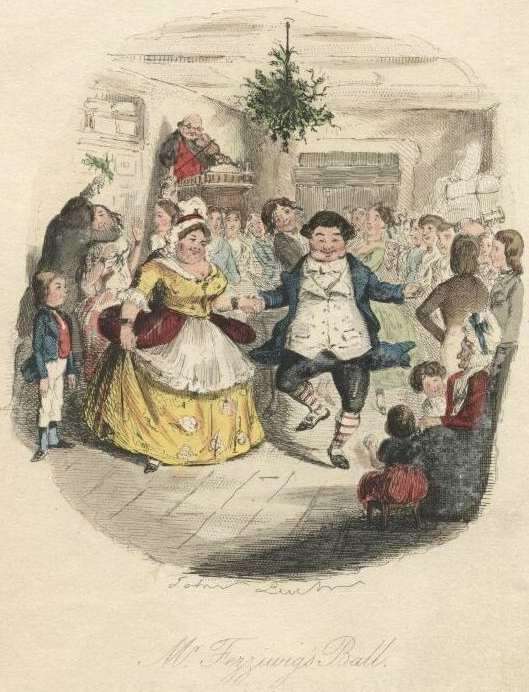
Illustration: “Mr. Fezziwig’s Ball” (1843), John Leech, from Charles Dickens’s A Christmas Carol. Public domain; source: Wikimedia Commons.
Explore more traditions, lore, and curious instructions in The Mostly Finished Pocket Guide to the Elsewhere.
Leave a Reply