
Recorded by Dame Keturah Auremont
Warden of the Embers, 1978–1986 · Grand Custodian of the Seven Keepings · Mistress of the Gilded Wheel · Professor of Biblical Antiquities, Comparative Divinities, and the Proper Distribution of Cheese
Being a corrective lecture on the seven obligations of a civilized hearth, with certain necessary observations regarding theology, table settings, and a wholly avoidable incident involving a wheel of Stilton.
There are Seven Keepings of the Hearth.
Seven.
Not six. Not eight. And certainly not the thirteen proposed by Parker Tender after an evening during which someone entrusted her with a ceremonial bell.
I have examined the surviving accounts, the disputed accounts, the accounts that were written on the backs of tavern receipts, and one document purporting to be a sworn statement from a goose. The answer remains seven.
Before proceeding, I should correct a misconception. The Keepings are not seven amusements with which to fill a winter evening. They are seven obligations, and the distinction matters. An amusement can be abandoned when one grows tired. An obligation waits patiently at the door until someone has the decency to answer it.
I am a Christian, a biblical scholar, and an admirer of rigorous study wherever it leads. I have read the accounts of Abraham welcoming strangers, of Ruth gleaning in a field not her own, and of a teacher who spoke of feeding the hungry and receiving the stranger. I have also studied the sacred hearth of Hestia, the Roman worship of Vesta, and the very different traditions associated with Brigid. These are not interchangeable divinities or doctrines, and anyone who says otherwise shall be assigned additional reading.
Yet these histories ask a recurring human question: what becomes of us when the fire belongs only to those who can afford its fuel?
Thomas Vale, who possessed fewer theological qualifications than I do but rather better instincts than a distressing number of credentialed men, answered with a chair.
The First Keeping: Shelter
On the first night, make room.
This sounds elementary. It is not. People have devised astonishingly sophisticated methods of keeping other people out: locked gates, elaborate invitations, rules about clothing, and the dreadful sentence, “We simply haven’t the space.”
There are moments when space truly is scarce. The First Keeping does not command a family to endanger itself. It asks us to look carefully before we declare that the doorway is full.
When neighbors entered the Vale home in December 1894, its parlour was small, its chairs mismatched, and its host far too proud to accept coal without an argument. Nevertheless, Mr. Bell crossed the threshold. Thomas shifted his chair. Someone found a stool.
The room did not become larger. The welcome did.
I have attended receptions in halls of extraordinary size that offered less shelter than that one cramped parlour.
The Second Keeping: Sustenance
On the second night, feed someone.
And before anyone interrupts to explain that nourishment need not always take the form of a meal, I am perfectly aware. I have a doctorate. I also have a kitchen.
Mr. Bell brought yesterday’s bread. Another neighbor brought potatoes. A widow arrived with preserves. Nobody pretended these offerings were a royal banquet, yet neither did anyone apologize for them.
It is here that I must address cheese.
A proper cheese board requires attention to ripeness, temperature, texture, accompaniments, and—
Archivist’s note: Three pages on the comparative treatment of hard and soft cheeses have been preserved in the unabridged edition.
I see that my editor has intervened. Very well. The point is not the cheese itself, although I remain unconvinced that my editor understands this. The point is that food offered with care tells a guest: I expected you to matter.
Food is not a prize awarded to the deserving. Hunger is not an examination one must pass before supper.
The Third Keeping: Fellowship
On the third night, remain.
Shelter opens a door. Sustenance sets a plate. Fellowship pulls up a chair and asks how the day has been—and stays long enough to hear an answer more complicated than “fine.”
I have known people who could distribute one hundred meals in perfect order yet could not spare five minutes to learn a recipient’s name. Their efficiency was admirable. Their hospitality was incomplete.
Thomas Vale spent much of his childhood near the fire, reading because books traveled where his body could not easily go. His disability did not make him a prophet, a saint, or an object lesson. It gave him a particular vantage from which he developed the habit of noticing.
He noticed who needed coal and who had coal to spare. He noticed who could sew, who could carry a crate, who could sing, and who ought never to be encouraged to sing again.
He made a ledger not to rank his neighbors, but to connect them.
Fellowship is the art of discovering that every person is more than the help they require—and more than the help they can provide.
The Fourth Keeping: Merriment
On the fourth night, laugh.
Here we encounter Miss Parker Tender, whose account of the Rituals of Misrule has recently enjoyed an inexplicable revival.
Miss Tender insists that merriment includes masks, crowns, theatrical grievances, villainous laughter, and the competitive cultivation of facial hair. I have checked the relevant archives and regret to report that she is not entirely wrong.
Long before HearthWarming, different peoples held festivals in which ordinary rules briefly loosened. Carnival’s season of indulgence before Lent, and European winter customs of mock authority, offer distinct examples of a useful truth: a community needs opportunities to laugh without asking permission from its most important members.
Laughter will not mend a broken grate. It will not purchase coal. But it may persuade a frightened family to sit together long enough to discover that someone is knocking at the door.
I do not personally endorse the ceremonial crowning of an unqualified fool.
Archivist’s note: Dame Keturah was elected Sovereign of Misrule in 1982. She instituted a seating chart.
That election was irregular.
The Fifth Keeping: Remembrance
On the fifth night, speak the names.
Not everyone who once sat at the Hearth will sit there again. Some have died. Some have traveled beyond returning. Some have been driven away by hardship, prejudice, or the ordinary cruelties that polite people prefer not to name.
To remember them is not to surrender the celebration to grief. It is to refuse the convenient fiction that only those present have contributed to our warmth.
In my own family, scripture and song passed between generations alongside recipes, questions, arguments, and the correct manner of welcoming a guest. My Christian faith does not erase my Jewish ancestry, and my study of other traditions does not require me to pretend that every sacred story teaches the same thing.
Different lives leave different embers. We honor them best by naming them accurately.
I would also remind my colleagues that a written record requires proper dates, legible handwriting, and labels that do not fall off the jars. Memory without organization is merely a cupboard full of unidentified preserves.
The Sixth Keeping: Generosity
On the sixth night, give what you can.
This is frequently misunderstood to mean giving away something one can easily spare. That may be a beginning, but it is not the whole of the practice.
A neighbor carried coal. Another shared bread. Someone repaired boots. Someone carried messages between homes. A person with little strength might offer careful records or patient listening. A person with no goods at all might offer presence.
The gift is not measured solely by weight, cost, or the volume of applause it earns.
It is measured, insofar as such a thing can be measured, by whether the giver has recognized a need and responded without making the receiver feel smaller.
I must emphasize this last condition. Public generosity that humiliates its recipient is an especially vulgar form of self-congratulation.
The Seventh Keeping: Belonging
On the seventh night, make the welcome permanent.
If Shelter says “Come inside,” Belonging says “There is a place here that remains yours.”
I have spent considerable time studying the biblical Book of Ruth. Its story concerns loyalty, vulnerability, migration, kinship, and the obligations people take upon themselves when conventional boundaries say they need not. It is not a simple parable, and I will not insult the reader by pretending otherwise.
Archivist’s note: The following digression on gleaning laws, inheritance, and disputed translations occupied forty-seven minutes of the original lecture.
Forty-nine. Your clock was slow.
Where was I?
Yes. Belonging.
When Thomas Vale began recording what his village needed and what it could share, he did more than manage supplies. He made it possible for neighbors to see themselves as responsible to one another. No one stood only outside the circle, waiting to be rescued. Each had a place within it.
Here I must disagree with Benjamen M. Lucerne, whose Concordance of the Four Assemblies is a magnificent work of scholarship and, in several places, a magnificent example of scholarship getting in its own way.
Lucerne is especially fond of distinctions: Emberwing here, Moonmere there, Thornvale in its proper column, and Starforge in a fourth. His classifications are useful, provided no one mistakes a neatly labeled page for a complete account of human beings. A person may find fellowship in one Assembly, purpose in another, and a home among people who have never asked which banner that person belongs beneath.
I am not proposing that we discard his Concordance. Heaven forbid. I have annotated my copy extensively, and one does not spend that much ink on a book one considers worthless. But the Seventh Keeping is not Classification. It is Belonging.
Archivist’s note: Dame Keturah’s annotations to Lucerne’s Concordance occupy two additional volumes. Lucerne’s reply, “I Was Merely Being Precise,” was never completed.
For once, my colleague’s title was entirely accurate. He was merely being precise. He had forgotten to be welcoming.
That is why the Seven Keepings culminate not in triumph, nor even in charity, but in belonging.
The Hearth is not ours because we guard it from strangers. It is ours because we keep making room.
A Final Instruction Regarding the Table
I have now explained all Seven Keepings, in their proper order, with exemplary restraint.
Archivist’s note: The original manuscript was delivered in three volumes and accompanied by a diagram of the cheese service.
An essential diagram.
Remember the obligations: offer shelter; share sustenance; practice fellowship; permit merriment; honor remembrance; act with generosity; and create belonging.
If you can remember nothing else, remember this: the First Hearth survived because no one mistook the fire for something that belonged to one household alone.
And now, at last, tea.
Do sit down. I have already set your place.
— Dame Keturah Auremont
Warden of the Embers, 1978–1986
For additional records of HearthWarming, consult The Mostly Finished Pocket Guide to the Elsewhere.
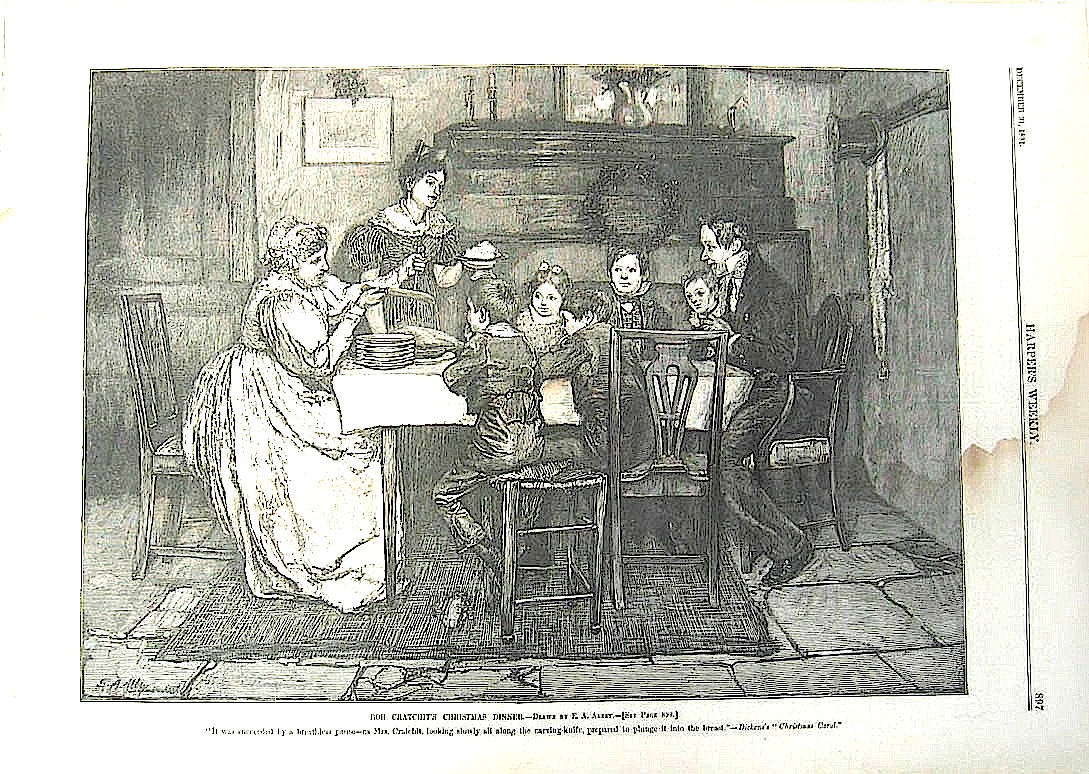
Artwork: Bob Cratchit’s Christmas Dinner, drawn by Edwin Austin Abbey (1852–1911), published in the nineteenth century in connection with Charles Dickens’s A Christmas Carol. Public domain. Image reproduction: Wikimedia Commons.

Leave a Reply